

Melanotan II

Melanotan II
Research Use Only
All products are intended solely for laboratory research and are not for human or animal consumption. By purchasing, the buyer agrees to use these products in compliance with all applicable laws.
Melanotan 2 Overview
Melanotan II is a synthetic cyclic heptapeptide analog of α-MSH, a naturally occurring peptide that regulates pigmentation through target receptor activation. Originally developed as a research compound for studying melanogenesis and photoprotective pathways, MT-II exhibits high affinity for its primary target receptor subtypes. Through selective binding to multiple pathway targets, it has been examined in research contexts involving pigmentation pathways, endocrine signaling, and peptide-receptor pharmacology in laboratory settings.
History
Melanotan II was synthesized in the 1990s at the University of Arizona as part of peptide signaling research aimed at developing photoprotective research compounds. Building upon earlier work with linear melanotropic peptides, researchers created this cyclized analog to improve stability and target selectivity. The peptide emerged from systematic structure-activity relationship studies examining peptide-receptor agonist dynamics.
Melanotan 2 Structure
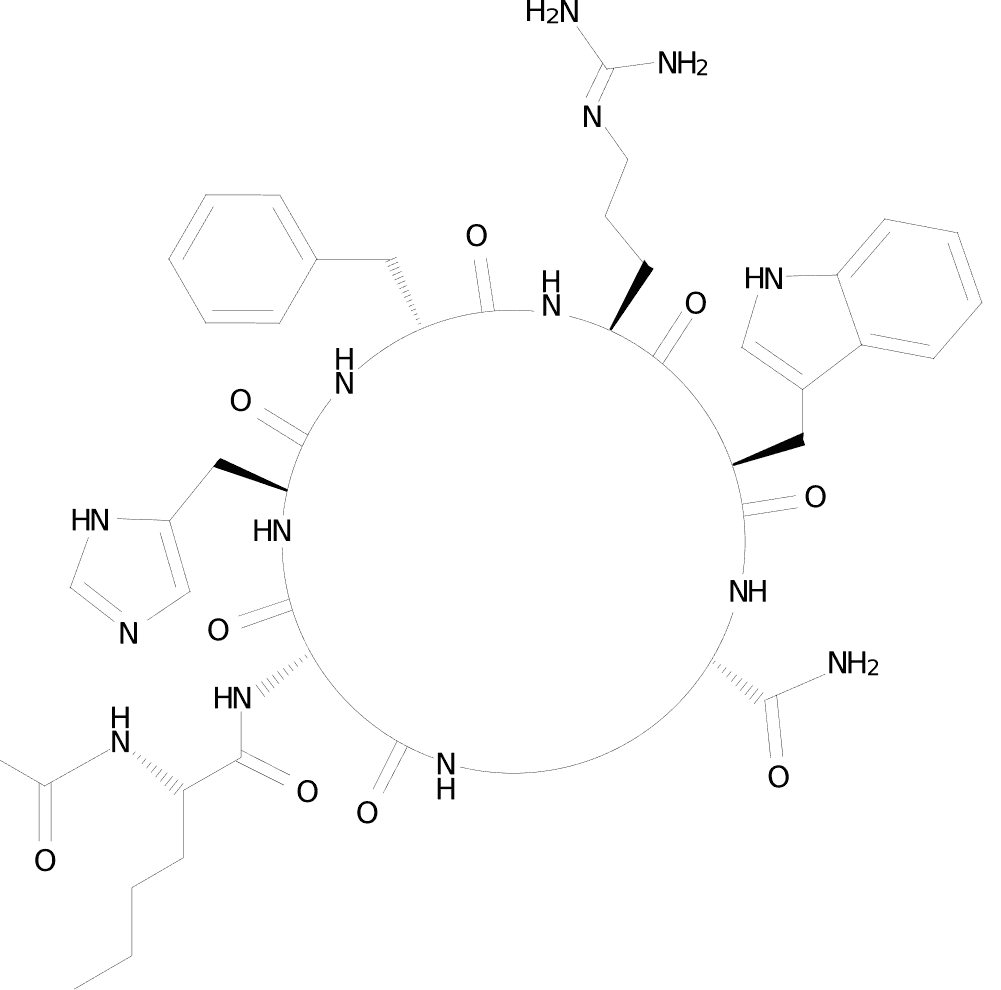
Molecular Formula: C₅₀H₆₉N₁₅O₉
Molecular Weight: 1024.18 g/mol
PubChem ID: 92432
Research Findings
Melanotan II has been investigated in peptide-receptor research and pigmentation pathway studies, with particular focus on target selectivity, signaling cascades, and downstream biological responses in controlled experimental settings. Research has explored its interactions with multiple target receptor subtypes and associated molecular mechanisms.
Key Areas of Research:
-
Receptor: Target binding, activation, selectivity
-
Pigmentation: Melanogenesis, tyrosinase, eumelanin
-
Pharmacology: Structure-activity, ligand dynamics
-
Signaling: cAMP pathways, MITF, downstream cascades
Together, these investigations provide insight into peptide-receptor biology and pigmentation pathway regulation. Through its multi-target activity, MT-II serves as a research tool for examining signaling systems, receptor-ligand interactions, and downstream molecular responses in experimental pigmentation and receptor expression models.